Furnace repair or replacement? How to decide before winter in Northern Virginia
On this page · 8 sections
Every October, the calls start the same way. The first chilly night rolls through Annandale, somebody flips the thermostat from cool to heat, and the furnace either doesn't start, starts and smells funny, or runs and runs without warming the house. Then comes the question: can you fix it, or do I need a new one?
It's a fair question, and October is the best time to ask it. Right now you have options. In the middle of a January cold snap, you have a cold house and a decision you have to make in a hurry. Here's how we walk homeowners through the repair-or-replace call, so you can make it on your schedule instead of the weather's.
The short answer
Bottom Line Up Front
If your furnace has one failed part and a clean history, repair it. If it needs a service call every heating season, leaves rooms cold, or has a safety problem like a cracked heat exchanger, stop spending on it and replace it.
A repair is the right call more often than you might think, and it comes with a one-year labor guarantee. But there comes a point where every repair just buys one more season from a system that's wearing out. The goal is to figure out which side of that line your furnace is on in October, not on the coldest night in January.
on every repair
on a new install
on new equipment
The rest of this post covers the four questions behind that answer, plus a decision table at the end you can work through in a couple of minutes.
Question 1: Is this the first problem, or one of many?
A furnace that has run quietly for years and suddenly won't light usually has one failed part, and one failed part is what a furnace repair is for. We find the cause, fix it, and you get back to a warm house. Our repair labor is guaranteed for one year, so if that fix doesn't hold, it's on us.
The picture changes when the service calls start stacking up. If you've had a technician out every heating season for the last few years, and it's a different part every time, that's not bad luck. That's a system wearing out as a whole. Each repair buys you a season, not years, and the money you keep spending is money that could have gone toward equipment that's covered by a warranty.
Repair vs. replace at a glance
This is the comparison we'd go over with you in your utility room. Each row is a real factor in the decision. The highlighted column is the smarter call when that factor is the one driving your choice.
| Factor | Lean Repair | Lean Replace |
|---|---|---|
| Service history | First problem in years | A service call every season |
| What failed | One part, clearly diagnosed | Different parts, one after another |
| Comfort | Even heat once it's running | Cold rooms, runs nonstop |
| Noise | One new sound, one cause | Banging, rattling, and squealing |
| Warranty | Parts still covered | Coverage long expired |
| How long you'll stay | Selling soon | Staying for years |
| Safety | No leaks, venting sound | Cracked heat exchanger or venting problem |
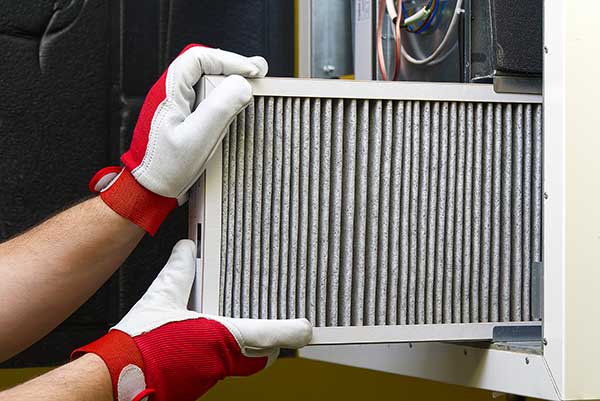
A clogged air filter is one of the most common reasons a furnace runs without warming the house, or shuts itself off early. Pull the filter and hold it up to a light. If you can't see light through it, swap it out and give the system a few hours. It's a five-minute job, and it can save you a service call.
Question 2: Is the furnace still keeping the whole house comfortable?
A healthy furnace heats the house evenly and cycles on and off without a lot of drama. Pay attention this month to what yours is doing. Is the upstairs freezing while the basement is warm? Does it run constantly and still not reach the temperature on the thermostat? Is it making new noises, like banging, rattling, or squealing, when it starts up?
Some of those are simple fixes. Some point to ductwork, a thermostat setting, or a blower problem. And some are the sound of a system that's reached the end of what it can do. That's why we always ask homeowners to be home when we do the diagnostic. You can see what we're seeing, ask questions on the spot, and walk away understanding the problem instead of just reading a line on an invoice.
Signs it's a repair
The furnace has life left and the problem is contained. Fix it and get through winter.
What we look for
- One problem, traced to one part, on a furnace that has otherwise run without complaint.
- The whole house heats evenly once the system is running again.
- No gas smell, no venting problems, and no cracks in the heat exchanger.
- The equipment is still covered by its manufacturer warranty.
Signs it's a replacement
The furnace is failing as a system. Repairs are buying one season at a time.
What changes the answer
- A technician has been out every heating season, for a different part each time.
- Some rooms stay cold while the furnace runs and runs without reaching the thermostat setting.
- Banging, rattling, or squealing every time the system starts up.
- A cracked heat exchanger or a venting problem that makes the furnace unsafe to run.
Question 3: Is there a safety concern?
This is the one question where the answer can make the decision for you. A gas furnace that's leaking, venting poorly, or showing cracks in its heat exchanger isn't a system you patch and hope for the best. When we find a problem like that, we'll show it to you, explain exactly what it means, and tell you straight whether the furnace is safe to keep running.
If you smell gas when the furnace kicks on, don't keep running it to see if the smell goes away. Get everyone out of the house and call your gas utility from outside. Make sure your carbon monoxide detectors have fresh batteries before heating season, too. A furnace can be fixed or replaced. Your family can't.
Question 4: How long are you staying, and what's the warranty picture?
When a furnace could honestly go either way, the tiebreaker is usually you. If you're planning to sell in the next couple of years, a solid repair keeps the house warm and the listing clean. If you're planning to stay, putting money into a tired system every winter rarely makes sense when a new furnace installation comes with a two-year labor warranty from us and a ten-year manufacturer warranty on the equipment.
Timing matters too. Replacing in the fall, before the first deep freeze, means you pick the equipment and the install date instead of taking whatever's available during a cold snap. We wrote more about that in why fall is the best time to replace your furnace.
The decision matrix
If you only use one part of this post, use this table. Find the rows that describe your furnace, then see which column comes out ahead. Most homes fit more than one row, and the right call is whichever column wins most of your rows.
| If your furnace… | Repair | Replace |
|---|---|---|
| Has one failed part and a clean history | Yes | Overkill |
| Needs a service call every heating season | Stopgap only | Yes, usually |
| Leaves some rooms cold while it runs nonstop | Diagnose first | If the system is worn |
| Has a cracked heat exchanger | Not safe to patch | Yes |
| Is still under manufacturer warranty | Yes | Premature |
| Is in a house you'll sell soon | Yes — keep it running | Buyer's call |
| Is in a house you'll stay in for years | If it's healthy | If it's worn out |
The bottom line
Plenty of furnaces that worry homeowners in October just need one honest repair and a good tune-up before winter. The ones that need replacing usually make it clear: repeat breakdowns, uneven heat, a safety problem, and an owner who plans to stay put. When several of those line up, replacing once on your own schedule beats patching your way through another Northern Virginia winter. If you're switching over for the season, our fall heat changeover guide walks through the basics.
If you're still not sure which side your furnace falls on, that's what our free onsite estimate is for. We don't quote replacements over the phone, because we'd rather see your system, your house, and your ductwork before giving you a number. We'll come out, show you what we find, and tell you honestly whether it's a repair or a replacement, even when the honest answer is the smaller bill. We work on all brands, across Annandale, Alexandria, Springfield, Burke, Fairfax, and the rest of Northern Virginia.
